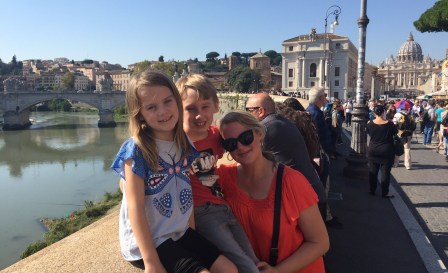
 After leaving Vatican City and St. Peter’s Square, we made our way down the road to Castel Sant’Angelo, Castle of the Holy Angel, named after the angel Michael. Legend has it the plague killed hundreds of thousands of people in the 500s, and in 590, Michael landed on top of the Castle, and the plague ended. Originally built in early 100s by Emperor Hadrian as a mausoleum for himself and family, it has been used as a fortress, castle, prison, and now museum.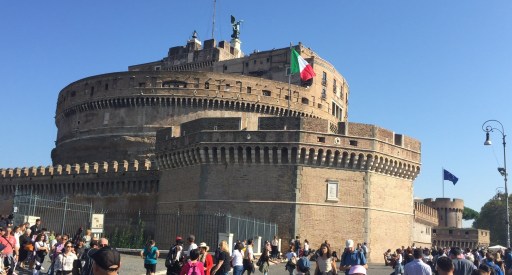

The Passetto di Borgo connects the Castel Sant’Angelo to St. Peter’s Basilica. It was built in 1277 and is 800m long. It was built, and has been used, as an escape route for the popes in danger.


A few minutes away, and right around the corner from our Airbnb was the amazing Pizza Zizza. While we waited a few minutes for our table, the fabulous owner brought us out some fried rice balls. We obviously liked them.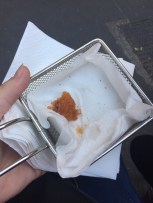 Andy and I enjoyed their specialty, the pizza platter. It was a sampling of six of their pizzas, each one amazing. The mushroom and fresh basil and mozzarella were my favorites, Andy loved the pesto and ham.
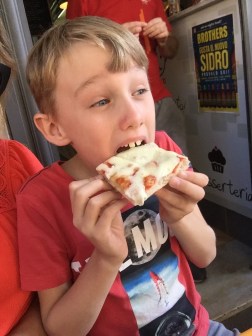
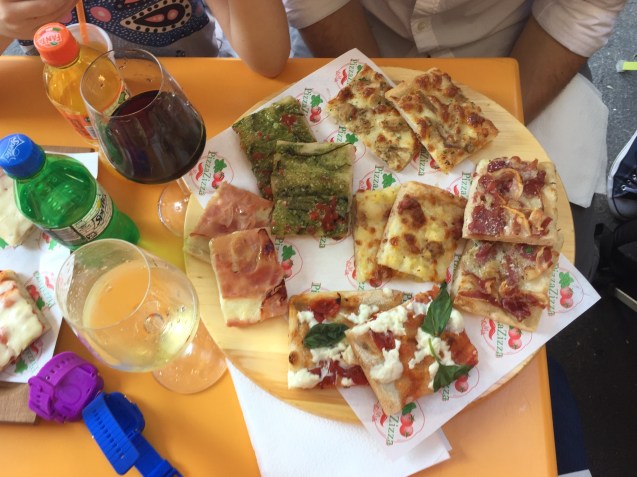 The kids loved their margarita pizza. If you didn’t know, the toppings on a margarita (margherita) pizza represent the colors of the Italian flag- red/tomatoes, white/mozzarella, green/basil. It was created in 1880 to honor Margherita, the Italian Queen. When Andrew finished his, they just brought him more. I cannot tell you how wonderful the hospitality is at this restaurant.
 And like a true Italian, Andy finished his meal with another expresso.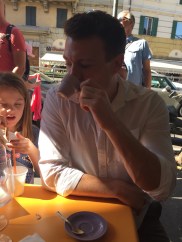
We started the evening walking up the Gianicolo (Janiculum), making our way to Trastevere. The Gianicolo is a large hill west of the Tiber, south of Vatican City, with beautiful panoramic views of the city.  At the start of the climb.
Atop the hill is the Fontana dell’Acqua Paola, a marble fountain built in the 17th century by Pope Paul V. It was later used as inspiration for the famous Trevi Fountain.
The bronze Garibaldi Monument. It honors Garibaldi, the hero who overcame the French attack on Rome in 1849. 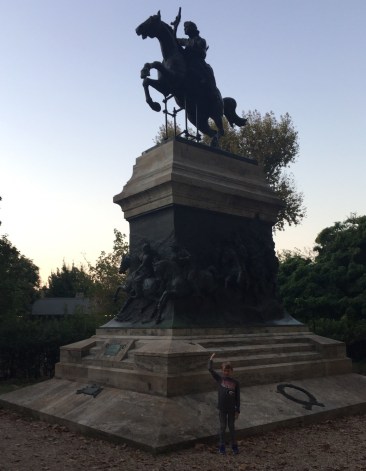
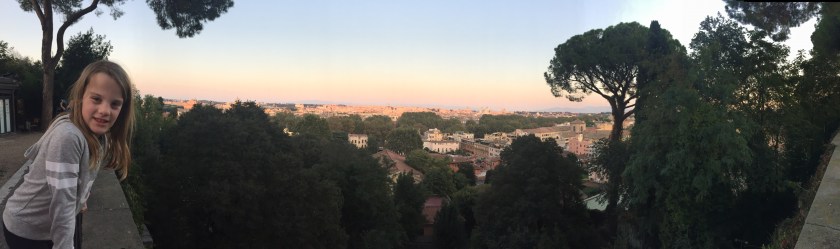


On Rome’s “Left Bank” is the Trastevere district. It has a medieval vibe with cobblestone streets, lots of bars and restaurants, and an eclectic mix of people. 
Rome’s oldest church, The Basilica de Santa Maria was established before 337 AD. The current church was built in the 12th century. It’s sits in Trastevere’s main square.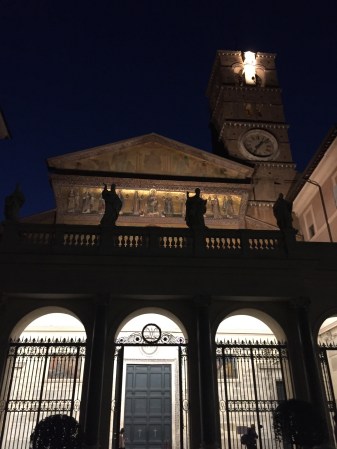

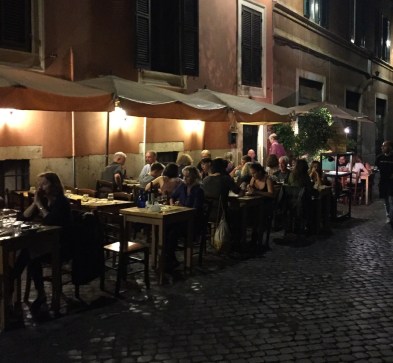 Dinner outside at Sette Oche. My favorite of the nicer restaurants we went to (we didn’t go to any super nice places due to it being an absolute waste on our kids at this point.) I had cacio e pepe, a new favorite I repeated through the trip, and a caprese salad (no before pics, I was hungry.) Andy had lemon linguine, Katherine meatballs, and Andrew (again) had a margarita pizza.


We walked home along the Tiber River. The historic center of Rome is the Ponte Sisto pedestrian bridge, built in the 15th century. Goodnight Rome.
xoxo-sk
ps. SPQR is Rome’s official symbol, coming from the Latin phrase “Senatus Populusque Romanus,” “the Senate and the people of Rome.” It dates back from 80 BC.


 xoxo-sk