Today we explored Ancient Rome. In the 8th century BC, Rome was ruled by Etruscans. What followed was the rise of the Roman Republic, in 509 BC. Kings were replaced by elected Senators, and Rome became powerful, taking over vast amount of the surrounding areas. A period of civil war and unrest came over Rome, with the ascent of the Republic’s last leader, Julius Caesar. With Caesar’s death, Octavius became the first Emperor in 27 BC. At this point, Rome was the largest city in the world and still growing. Rome’s population peaked in the 2nd century, and Imperial Rome began to take a downward turn. Barbarian invasions began, and in 330 Constantinople was made a second capital. The majority of Romans soon moved to the safer new capital, leaving Rome to its past glories.
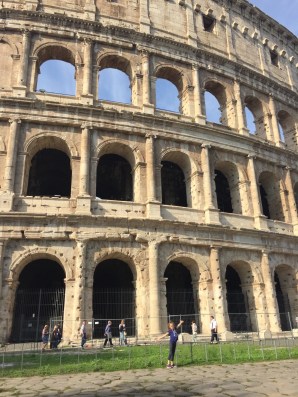
One of the Roman’s grandest architectural achievements is the Colosseum. Emperor Vespasian began building the amphitheater in 72 on the site of Nero’s decadent Golden Palace as a gift to the Roman people. It could hold over 50,000 people. It was used for gladiatorial contests, executions, reenactments, flooded for mock sea battles, and for basically any public spectacle. 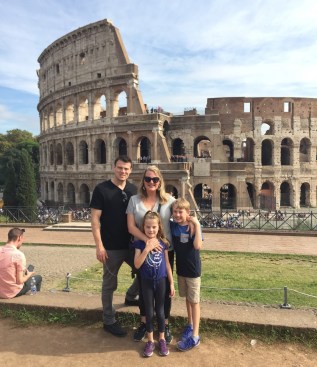
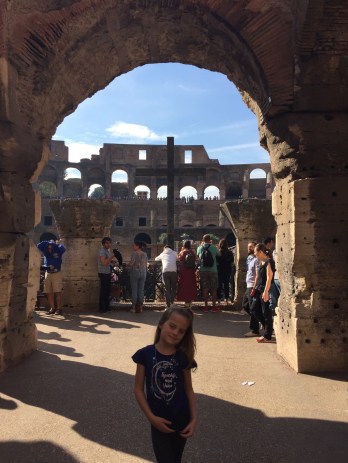


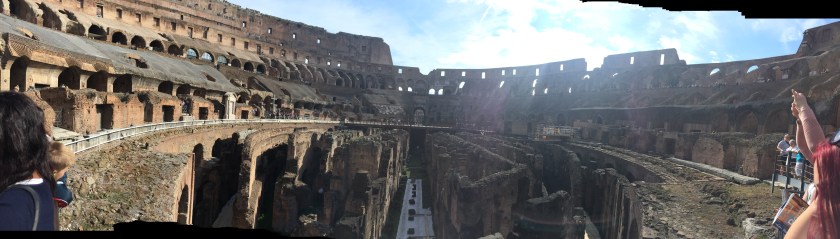 The original floor was made of wood and covered with sand. The hypogeum (hidden passageways) were underneath and connected to points outside the arena. The hypogeum had two levels and was full of corridors, cages, pulleys, and elevators to give the animals and gladiators access to the stage above.


The kids were (thankfully) really into the Colosseum. We had prepped them with some edited scenes from the movie Gladiator and some youtube videos so they could imagine what it was like back then.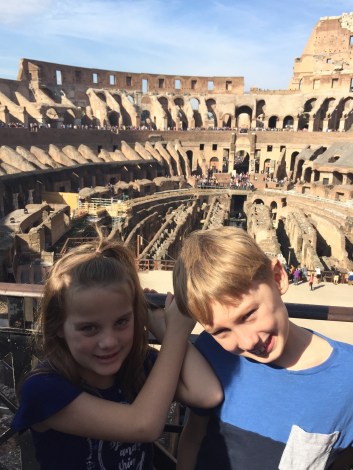
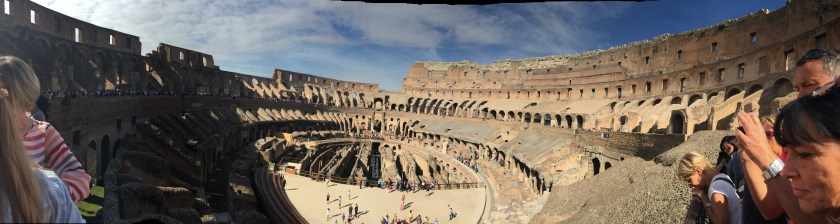
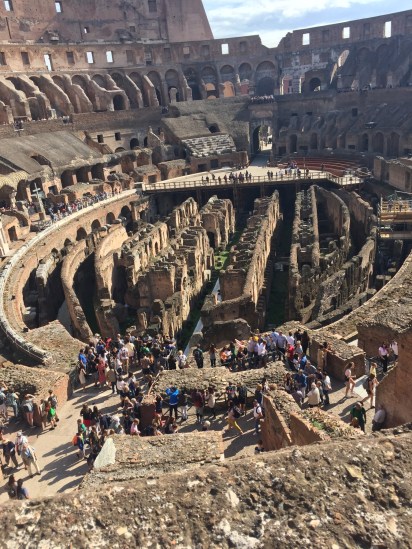 As you can see, there were defiantly a lot of people there (your tickets come with a certain time slot), but it wasn’t bad. We saw everything we wanted to see. Sometimes you may have to wait a minute or so to get a prime viewing spot.


View from the Colosseum of the Temple of Venus and Roma.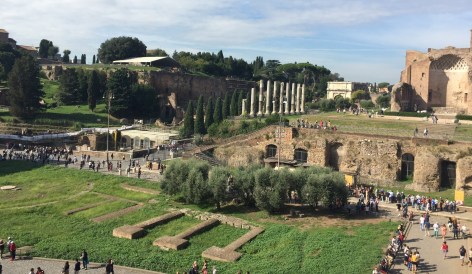


Parco del Celio.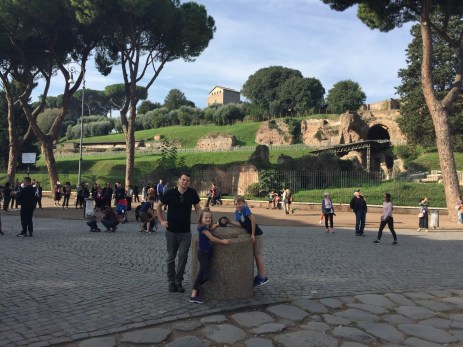
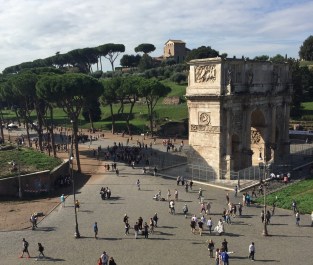 Arch of Constantine erected in 312. It lies between the Colosseum and Palatine Hill. (Picture is from the top of the Colosseum.)


Quick break for lunch at Café Café. So good. We didn’t have a bad meal here. A and K once again had cheese pizza and were happy.


Then we ventured to the most famous of Rome’s seven hills, Palatine Hill. Palatine Hill is one of the oldest parts on the city and overlooks the Forum on one side and Circus Maximus on the other. It was home to the great palaces of the Roman Emperors and the rich Roman Senators before them. (People have actually inhabited this area since the 10th century BC per excavations.) While day to day life took place in the Forum below, this is where the affluent and powerful lived.


At the foot of Palatine Hill is the is 1st century Arch of Titus. Arches were built to commemorate great military victories, with this one celebrating a victory in the Roman-Jewish War in Judaea. Near the Arch is the ruins of the Temple of Venus and Roma, built by Emperor Hadrian in 135 AD.  About to go up the hill. Legend has it that the hill was home to Romulus (the founder of Rome) and Remus.
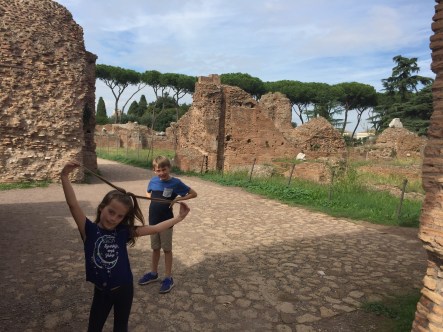
  The ruins of the Emperor’s great houses. Kids were unimpressed, but Andy and I loved it.
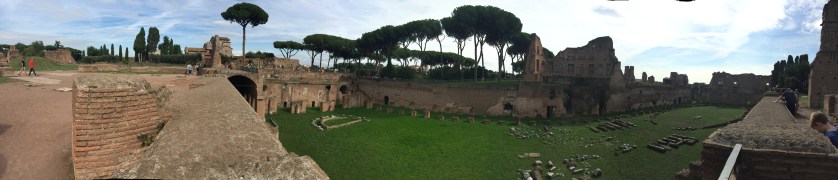
 Palace of Domitian garden/stadium.
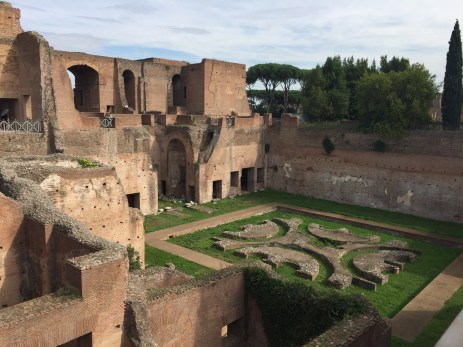
 Water garden courtyard of the Domus Augustana.
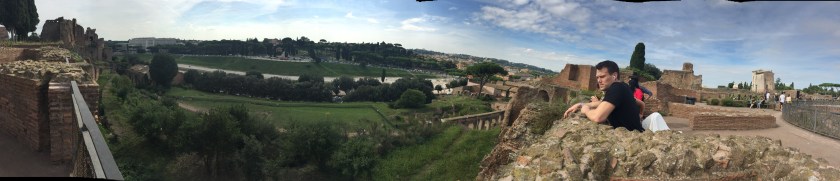
 Overlooking Circus Maximus.
 I think the Forum was Andy’s favorite place we visited here. He took Latin in high school and came here on a school trip.
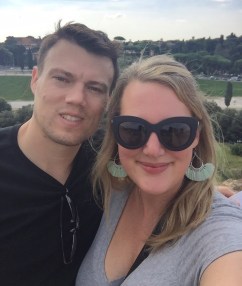 The Nymphaeum of the Mirrors, a niche built into the ancient walls as you make your way down the hill.
 Halfway up the hill, overlooking the Forum below. As early as the 7th century BC, the Forum was where all the action happened in Rome. It was the political, commercial, and religious center of Rome. It has been added onto and rebuilt over time; most of what we see now is from around the 1st century BC.
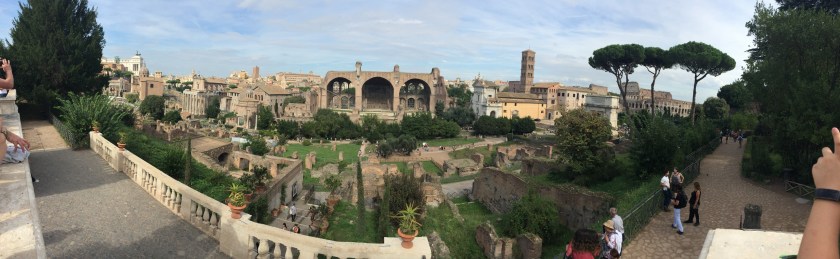 The Forum’s largest building was the Basilica of Maxentius and Constantine, built in 312 AD.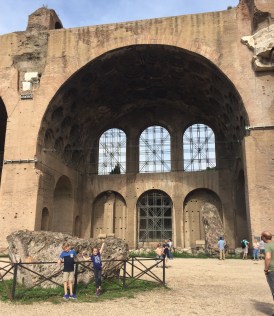
The Domus Tiberiana, another Emperor’s Palace built into Palatine Hill, seen from the Forum.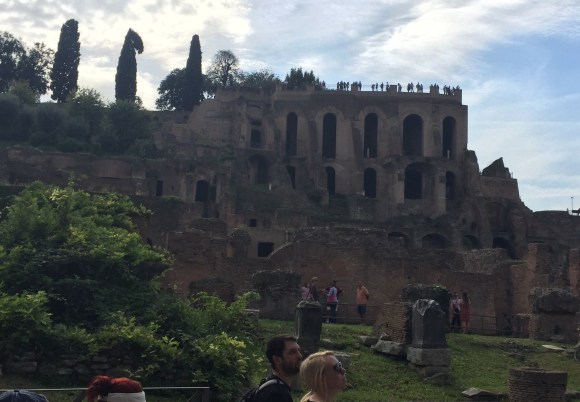
The Temple of Romulus, built in 307 AD. It was later turned into a vestibule for the Catholic church, Santi Cosma e Damiano, in 527. The green door and lock are original to the building.


The Temple of Antoninus and Faustina was built in 140. Emperor Antoninus built it for his wife when she died. His name was added upon his death. So romantic.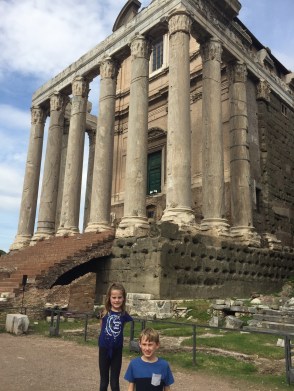
At this time, the kids were beginning to be over it, the Colosseum had been cool, but a bunch of rocks didn’t quite have the same entertainment value. They powered through.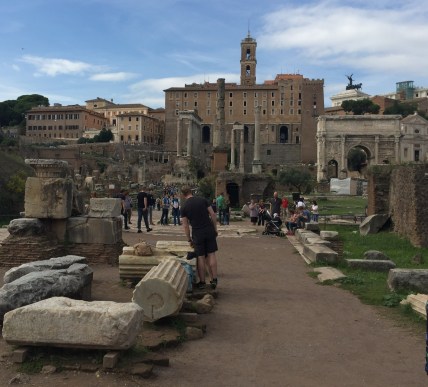
The Temple of Castor and Pollux from the end of the 1st century BC. Castor and Pollux were the sons of Leda and Jupiter and in 499 BC led the Romans to victory over the Latins. Upon their celebratory return to Rome, they went to Juturna Springs with their horses and then were never seen again. Juturna Springs. It was said these waters had healing properties.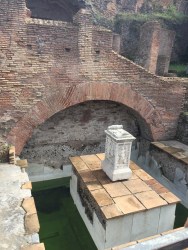
The Temple of Vesta was originally a circular temple, with the Sacred Fire of Vesta at its center. It was first built in the 7th century BC and has been rebuilt many times. The fire was tended round the clock by Priestesses who began their service before the age of ten. The eternal fire was extinguished and the Vestal Virgins disbanded around 380, when Emperor Theodosius made Christianity the official religion. The House of the Vestal Virgins was where the women lived to serve out their thirty year term of service. After they left their position of honor they were free to marry.

The Temple of Caesar. After his assassination in 44 BC, Augustus built a temple to honor his adoptive father in 29 BC. It was built on the site of his cremation, and it is also where Marc Anthony read his last will and testament and gave his famous eulogy. 1600 years later Shakespeare would immortalize Anthony and his (fictionalized) speech in his play Julius Caesar. I actually had to memorize Shakespeare’s version of Anthony’s speech in High School, and I still remember it, at least the first 10 lines or so. “Friends, Romans, Countrymen, lend me you’re ears.”

The very surprisingly unimpressive looking Curia. Then Curia was were the Senate met. The one today had been restored, but was originally was built by Julius Caesar in 44 BC. It was turned into a church in the 7th century.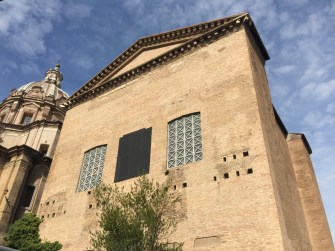
At the edge of the Forum, is the Arch of Septimus. This Arch was built in 203 and commemorated the Roman defeat of the Parthians.
At one time, the Umbilicus Urbis marked the center of the city, from which everything was measured. The original was from 2nd century BC, and the existing one is from 203 AD.


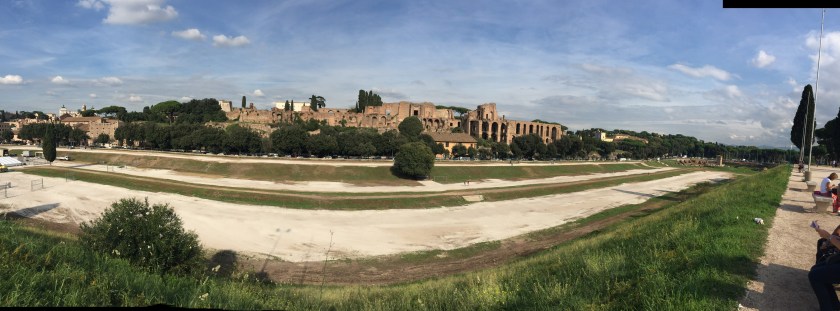
The view from Aventine Hill (another one of Rome’s seven famous hills) of the Emperor’s Palaces and Circus Maximus. Circus Maximus lied in the valley between the two, the Romans used it for chariot racing and their Roman games. It was in use from 6th century BC to 6the century AD. At its largest in 1st century AD, it held 250,000 people. Currently, it is a public space used for festivals and concerts. Ok, at this point, the kids are tired and my feet hurt. 
The Arch of Janus from early 4th century AD. The Rhino statue is pretty recent I think. 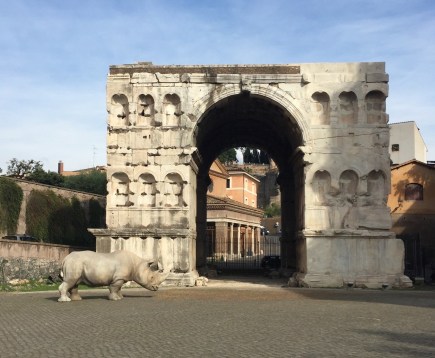
 The Mouth of Truth/Bocca della Verità has been located at the Santa Maria de Cosmedin Church since 1632. It is a marble mask of the sea God Oceanus. Legend has it that if you put your hand in the mouth and tell a lie, he will bite your hand off. There was a long line to put your hand in so we just grabbed a picture and moved on. Kids were done, I don’t blame them. A lot was seen today.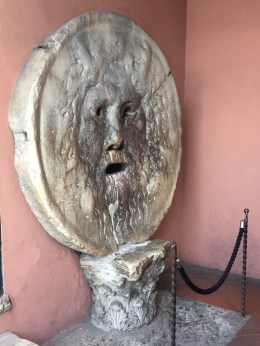
Across from the Mouth is the Temple of Hercules Victor in the Forum Boarium. The circular marble temple dates back to 2nd century BC.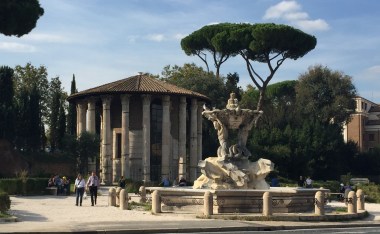
Ending the day with a gelato stop. Nutella Chocolate/Lemon for K and Strawberry Cheesecake and Caramel for Andy and me. Weird combo I know.
xoxo-sk
ps. We love a walkable city. Besides getting to and from the airport, the only time we took public transport was to the Colosseum/Forum. The kids were grateful.
 xoxo-sk
Thank you Susanne for this wonderful tour of ancient Rome… what an adventure , I KNOW your feet hurt!!
LikeLiked by 1 person