We continued our afternoon in Buda with a much anticipated stop at the Labyrinth. It is a huge network of natural underground caves and tunnels that run throughout Castle Hill that have been used in the past as cellars, shelters, and a prison.


Andrew is super ready to explore. The Opera Panopticum exhibition, celebrating the music of Hungry in the 19th century. It looked like a creepy masquerade party.
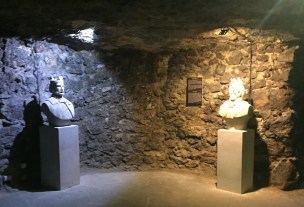


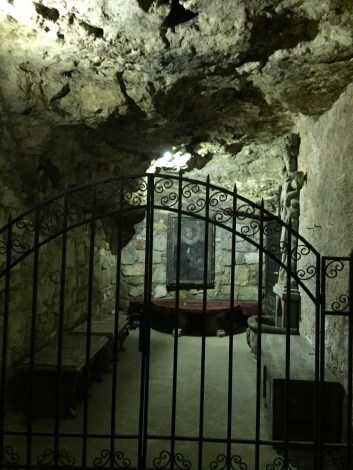 Later made famous by Bram Stoker, Dracula has always been feared and known for his cruelty. He was often referred to as “Vlad the Impailer” or the Vampire of Havasalföld (his Castle.) According to Bonfini, the biographer of King Matthias, Vlad III Dracul was captured by the King in Transylvania in 1462 and transferred to the Labyrinth’s prison for a ten year sentence. Reasons were never really given. His wife, Justina Szilagyi was cousin to Matthias.


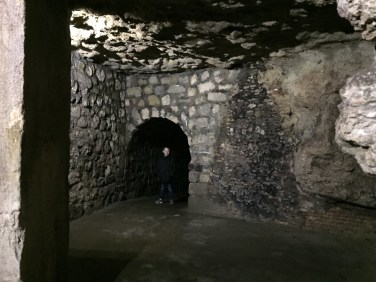 Andrew loved it! There were parts that were pitch black and foggy, you were supposed to walk with the assistance of a rope. It freaked K out.
The Mary Magdalene Tower or Buda Tower was once a part of the Mary Magdalene Church, built in the 13th century. It was the only Church that remained opened to Catholics and Protestants during the Turkish occupation. The Church was severely damaged during WWII and only the lone tower was left and rebuilt. In front of the the Tower is a bronze cast of the coronation mantle worn by the Hungarian Kings. It was first used in 1031 by King Saint Stephen and the last used by King Charles IV in 1916.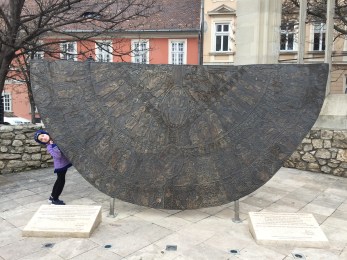
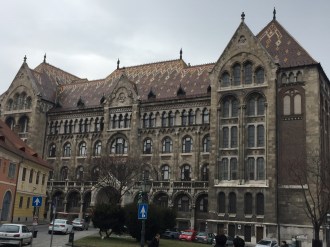
 The Medieval Jewish House of Prayer. It is a restored 14th century Synagogue and now a Museum.
 No clue what this building actually was, but I really though it was interesting. I looked it up later and it’s a Salon?! Ok.
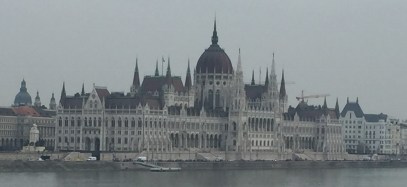
 The massive Hungarian Parliament in Pest as seen from across the Danube in Buda.
 Heading over the Margaret Bridge back into Pest. Over Andy’s shoulder you can see the Parliament in Pest, and on Andrew’s side is Buda’s Castle Hill in the distance.
 After making it across the bridge, back to Pest in one piece, we caved and got the kids McDonalds. Our go-to order is a shared 20 piece nugget, large fry (no drinks, we always carry water bottles.) They’ve been troopers.
  Walking along the Pest side of the Danube, you can see Buda Castle in the horizon.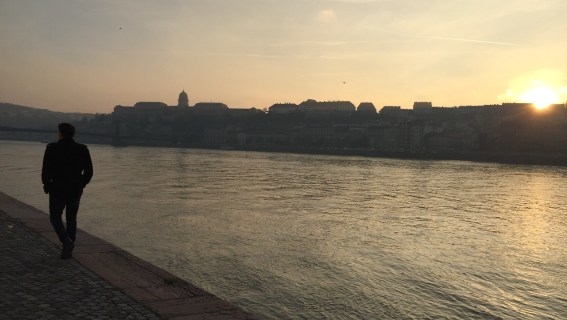
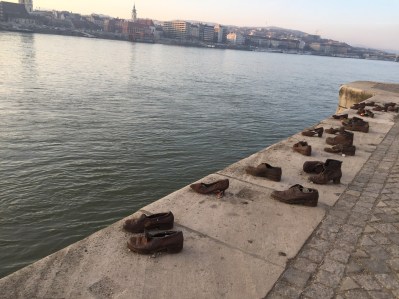 Along the riverside promenade is “Shoes on the Danube Bank.” It’s a memorial to honor the 3,500 people (800 Jews), killed by Militiamen from 1944-45 during WWII. People were ordered to remove their shoes, and stand at the waters edge. When they were shot, their bodies fell forward into the river and were washed away, leaving only their shoes behind. There are sixty pair of iron shoes, some women’s, some men’s, and some belonging to children. A very visual and visceral reminder of some of the horrors of the time.

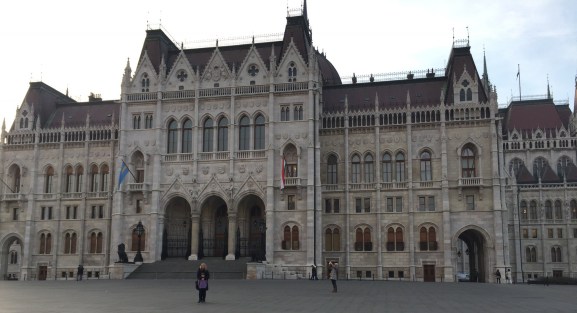
 The Hungarian Parliament Building is the largest building in Hungry and was finished in 1904. It has 691 rooms and 12.5 miles (20km) of stairs. After WWII, in 1949, Hungry became a People’s Republic, a Communist/Socialist government. A red star was added to the top of the building. They were under the Soviet’s umbrella. In 1989 a parliamentary republic was put in place, and the star was removed. The unicameral, National Assembly of Hungry, currently uses the building. The Prime Minister’s office is elsewhere.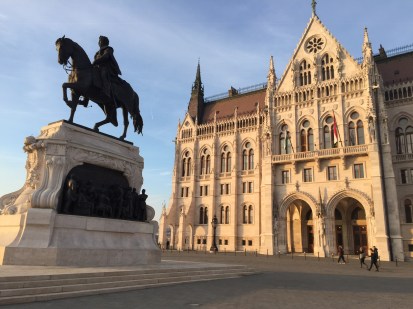
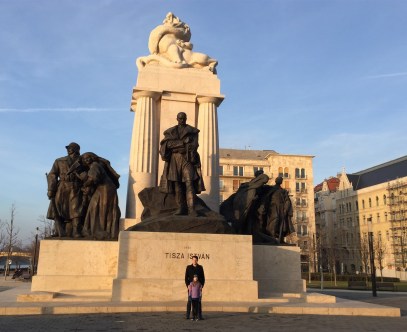 Gróf Tisza István Mounement. He was a former Hungarian Prime Minister.
 Then Kossuth Memorial, built in the early 1900s, celebrating the former Hungarian Regent-President Lajos Kossuth.
  In the Square there is a memorial to the victims of the 1956 massacre at Kossuth Tér. The victims were protesters of the 1956 Hungarian Revolution against the Communist Soviets. Not much is known about what happened, with the number of victims ranging from 22 to 1000.


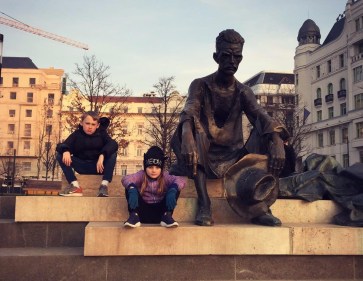 A and K sitting with Hungarian poet Attila József.
 Our Airbnb was around the corner from St. Stephen’s Basilica.
 Calling it a day.
 xoxo-sk
ps. This cracked my up. It’s grilled cheese. Like, cheese that is cooked on the grill. To my eternal regret, I didn’t try it for some reason.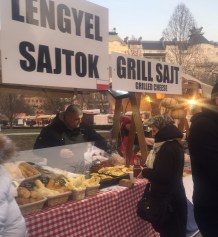


 I did not know before this trip that Budapest was a combination of two cities, the old town Buda and the newer Pest, bisected by the Danube River.
  As you walk across the Chain Bridge you can see Buda Castle looming over you.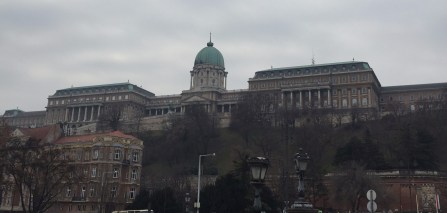


 King Béla IV built the first royal residence on Castle Hill in the mid 13th century. Following Kings extended and reinforced the Castle and it’s outlying additions. By the 15th century, King Matthias’s court had brought Buda to European prominence. In the mid 16th century the Turks invaded Buda, and it became part of the Ottoman Empire. They were eventually defeated in 1686 by the Austrian Hapsburgs and allies, and the medieval palace destroyed during the battle. The Habsburgs annexed Buda into their empire and reconstruction begun. Various battles/wars and rebuildings have taken place over the years (after WWII specifically.)

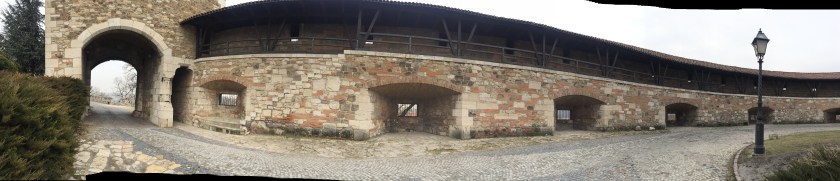 The Great Rondella, the remnants of the medieval fortress of King Matthias (recently repaired.)



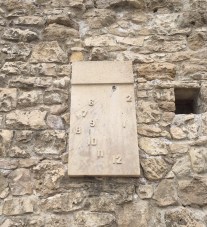


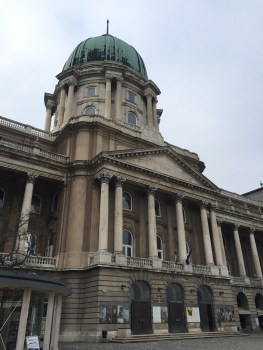 Buda Palace, which it must be said, looks much more impressive and magnificent from a distance (lit up at night especially) than it does up close. It is now home to the Széchenyi Library, Hungarian National Gallery, National Archive of Hungary, and Budapest History Museum.
 In the Lion’s Courtyard of the Palace is the Matthias Fountain. It is crazy looking. It depicts King Matthias leading a hunting party, it includes a dead deer, hawks, and dogs.

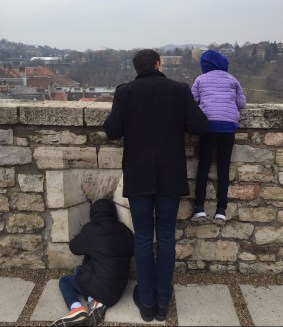
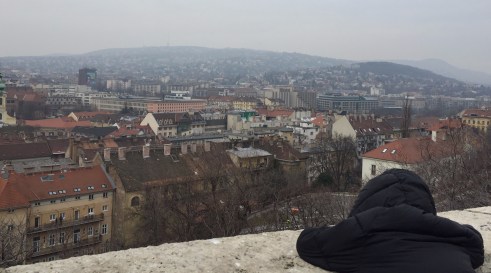 Andrew overlooking the Buda Hills.
 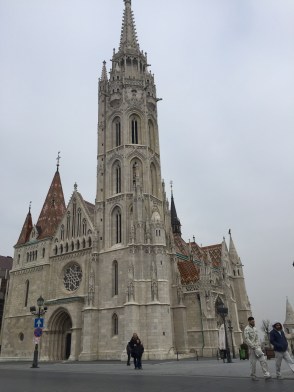 Matthias Church was originally constucted in 1015 by the first Hungarian King, Saint Stephen. That building was destroyed in 1241, and the current Church was built in the 14th century, with restorations taking place in the 19th century as well. When Buda was occupied by the Turks, the Church was turned into a mosque. It lasted for 150 years until the Turks were driven out of Hungry by Christian missionary forces in 1686.


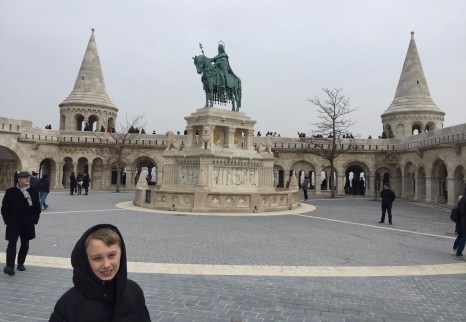 Right beside Matthias Church on Castle Hill is Fisherman’s Bastion. It is a viewing terrace, with towers and walkways, built in the late 19th century. A bronze statue of Stephen I sits in its courtyard.
  The twins in one of the seven towers overlooking the Danube River.
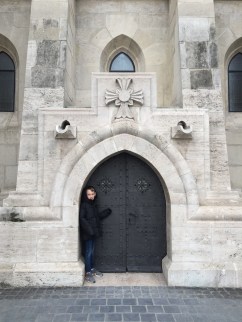 An Andrew sized door.
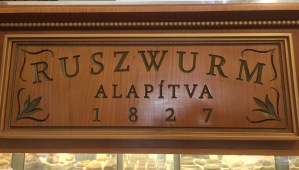 We went to Ruszwurm Bakery in Old Town Buda and had sour cherry strudel, a Dobos tort, and their famous cream cake. It was amazing, totally recommend going there. If it was on our side of the River I would totally go again (and again.)
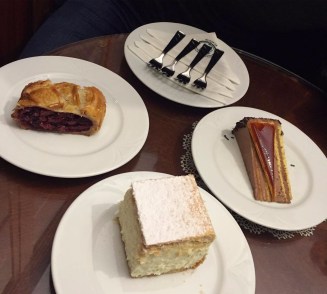 And what real life looks like.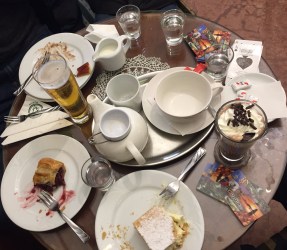
 xoxo-sk


 Drinks at Bar 7 and dancing at Zefside, with some super fancy flaming drinks. I was super smooth and burned my napkin.





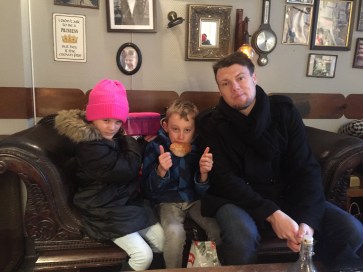 Apple cake and warm chocolate. Not hot chocolate, warm and usually made with dark chocolate. Much to Katherine’s disappointment, things aren’t as sweet here.


 xoxo-sk