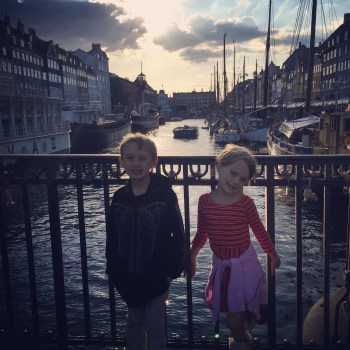
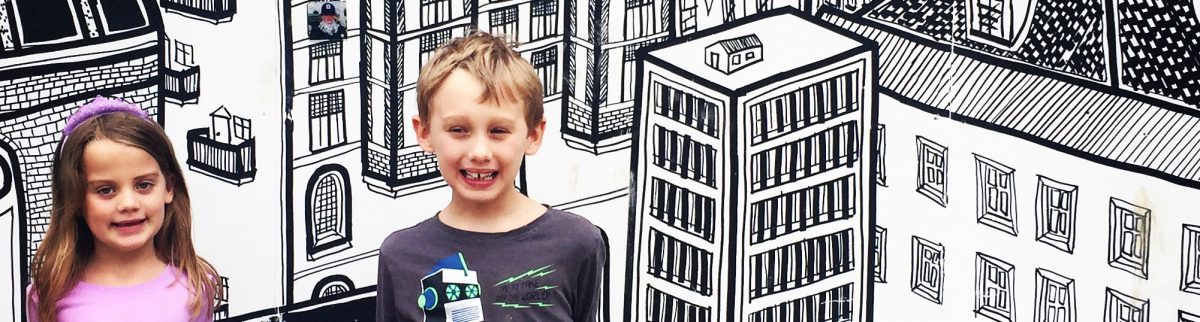
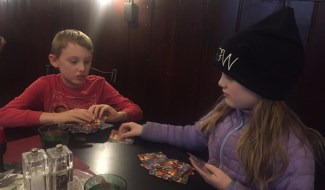
Everyone is excited (look at the faces) for Vienna! Vienna is Austria’s capitol, and the majority of people here speak German. Vienna was settled by Celts as early as 500 BC, and then used as a military base for the Romans in 15 BC (defense against the Germanic tribes.) In the 15th century, it became the center of the Holy Roman Empire, with Vienna becoming the base for the Habsburg dynasty. During the Napoleonic Wars (1804) it became the official capitol of the new Austrian Empire.


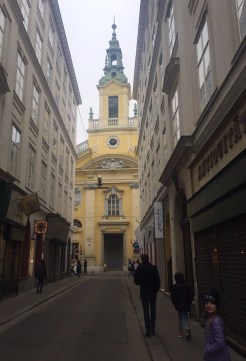 After checking into the hotel, we headed past the Evangelical Church HB (Reformed City Church) for some lunch at the Wiener Küche. We shared some schnitzel, potatoes (both fried and creamy), and apple streusel. I also had some kind of squash soup, at least that’s what I think it was. Doesn’t really matter; it was a lunch special, and it was good.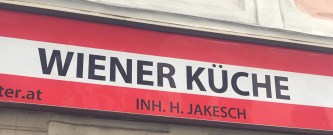


 We started our Viennese exploration at the Hofburg Palace. The Hofburg was the home of the Royal Habsburgs for 600 years. It was built in the 13th century as a medieval castle and expanded with each new emperor’s reign. The Hofburg is a massive complex, consisting of 18 wings, 2,600 rooms, and 19 courtyards. Presently, it is the home and workplace of the President of Austria, with 5,000 people living and working there.
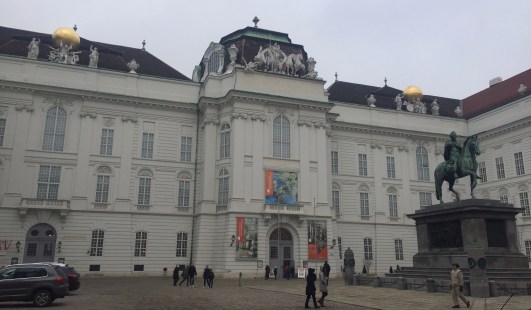 The Amalienburg (above) was built in the 16th century, and it houses Empress Sisi’s apartments, part of the Imperial Apartments we toured.


Interior Courtyard of the Hofburg with statues of Emperor Francis II.


We explored the massive Silver Collection first. There are 7,000 items displayed.


My new favorite way to explore museums/castles/etc. are self guided audio tours. Andrew especially loved it. You go at your own pace. The Hofburg did a great job telling interesting stories about each thing.  Kids were pretty impressed with the massive (30m!) gold Milan Centerpiece.
  A plate collection selfie.
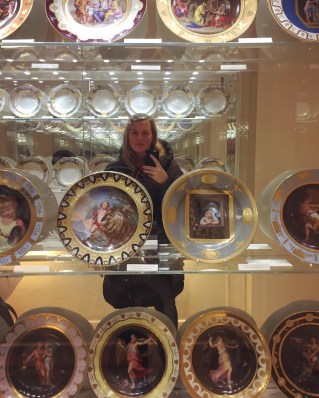 The end of my legally taken pictures in the Silver Collection.
 A scale model of the Hofburg circa 1900.
 I am usually very much a rule follower. But sometimes, I can’t help myself. I’ve found that with some Palaces/Castles you aren’t allowed to take pictures. Apparently, there is no photography permitted in the Imperial Apartments or the Sisi Museum. They don’t allow it because (the lady said) it slowed people down and (via the website) people were taking pictures with the flash on (big no no.) So, I didn’t feel too bad about sneaking some (quick and non flash) pics. Andy (of all people) didn’t like me misbehaving.


Emperor Franz Joseph and his wife Empress Elisabeth’s apartments. They were lovely, and the audio guide was really informative and interesting. The red room (above left) was the Emperor’s study. The blue/green room looks like a dining room, but was actually a conference room. The red room with the small bed was the Emperor’s bedroom.


We visited the Sisi Museum last. K loved listening to the stories about the tragic Empress Elisabeth. Sisi, as she was called, was born in 1837 in Munich, into the Bavarian royal house. At 16, she married Emperor Franz Joseph I. The Emperor was in love with Sisi, who was thought to be one of the most beautiful women in Europe. Unfortunately, she did not enjoy the Hapsburg court life, full of rules and protocols. She was unprepared, unhappy, and had a dominating Mother-in-law. Her first daughter died in 1857, and Sisi spiraled into a depression that would stay with her. Throughout her life Sisi exercised assiduously, fasted, and dieted. It was the only way she felt in control. (Her diet and exercise regime were really crazy, you can look up the details.) She gave birth to an heir in 1858, and seemed to get some happiness out of it, becoming more assertive at court. In 1889, her only son and his mistress committed suicide. Sisi never recovered from the tragic loss and withdrew from court. She traveled, usually incognito, and became obsessed with preserving her beauty. In 1898, while traveling privately in Geneva, Sisi was stabbed by an Italian anarchist. Such an interesting and sad lady.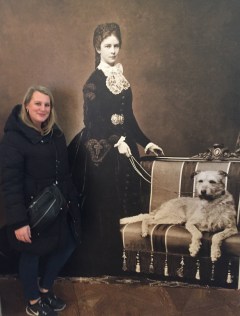
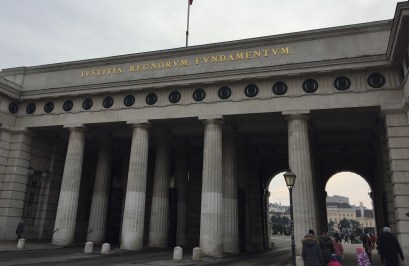 Walking from the Hofburg in Hero’s Square through the outer castle gate to the massive Maria-Theresien-Platz. We are standing in front of the Empress Maria Theresa Monument. She sits atop the monument, with her military commanders on horses below her. The Square is populated by various museums.
 Kunsthistorisches Museum, I think… There were tons of very similar beautiful museums in the Square (which we did not have time to visit.) I absolutely loved the sculptured bushes.


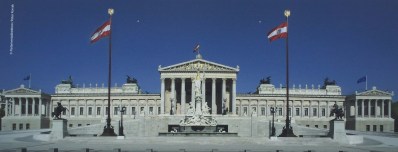
The under construction Parliament. The picture above is what it is supposed to look like. From what we could tell it is a beautiful building.


Continuing down Ring Road, we came across the Dr. Karl Renner monument in Rathauspark. He was an Austrian politician. It is one of the more interesting looking (not that well done?) monument/statues I’ve seen.


Vienna City Hall/Rathaus had a little winter festival going on in the Park in front of it. (It had a double decker ice skating rink!!)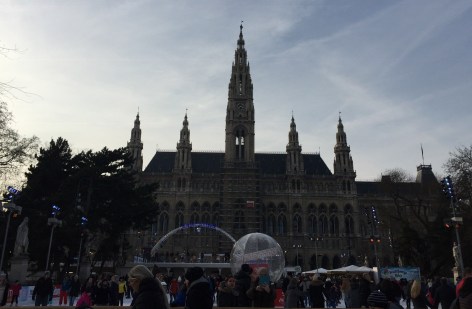 The City Hall is the seat of the local Vienna government. It was built in the late 19th century. Atop the 98m tower is the Rathausmann, a medieval knight, symbolically guarding City Hall.


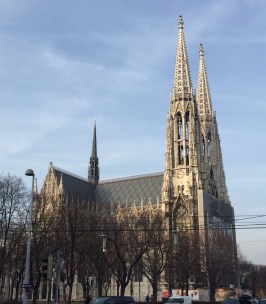 The gorgeous Votive Church (my fav Vienna Church) was constructed in 1879 after an assassination attempt on Emperor Franz Joseph (Empress Sisi’s husband) in 1853. The Church was built to give thanks to God for saving the Emperor’s life. It is built in the same Neo-Gothic style as the neighboring Rathaus. They look very similar.


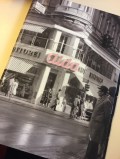 As the afternoon went on, Andy started to not feel good (this does not bode well, sickness usually hits the kids and me, but rarely him.) With hopes tea may revive him, we stop at Aida Cafe. We have the usual, English Breakfast for me and Earl Gray for Andy, with Apple Cake and Aida Cake with cream. After the amazing cakes and pastries at Ruszwarn in Buda, these paled in comparison.


Schottenkirche, Our Lady of the Scots Catholic Church founded in 12th century bu Benedictine monks.


Bis Auf Widerruf Gestatteter Durchgang (Until revoked permitted passage) sign atop the entrance to the Freyung Passage, a fan shopping arcade with a fancy fountain.


 Church on the Court (or Church of the Nine Choirs of Angles) was built at the end of the 14th century. It is located in the Am Hof, one of the most historic Squares in Vienna.
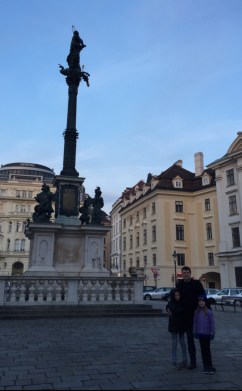
 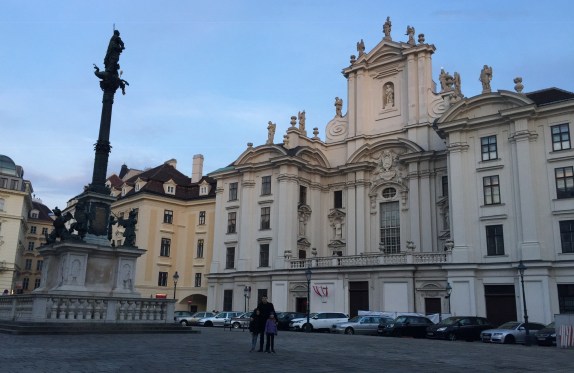 In the center of the square is the Marian Column, built the in thanks of Mary for helping defeat the Swedish during the Thirty Years’ War.
Peterskirche/ The Church of Saint Peter is believed by some to date back to the times of Charlemagne. A Roman church, built on a Roman settlement, in the 4th century. The newest version of this Church is a Baroque creation, built in the early 1700s.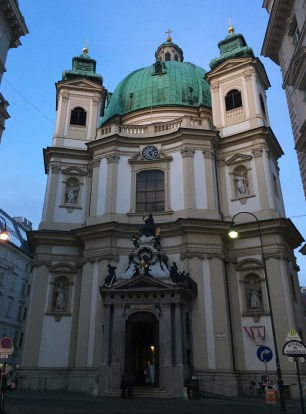


Andrew and I in front of the Plague Column on Graben. The Column was built after the Great Plague epidemic in 1679. It is a really cool looking sculpture, and you can’t really see it well in this picture.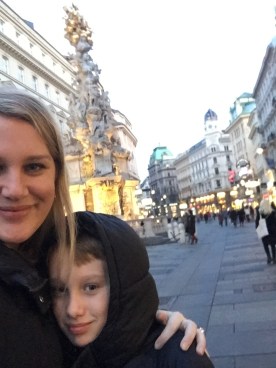 A quick stroll by the apartment Mozart and his family lived in from 1784 to 1787 when he was at his creative peak.


 Dinner was a shared sausage the size of K’s head (and she has a big head.)
 xoxo-sk
ps. The day ended with Andy feeling rough, and us all turning in early. It’s not always pretty. #reallife
 xoxo-sk