I could’ve spent all day here. (I could say that about a lot of stuff here.) I took too many pictures. (I could say this as well about a lot of stuff here.)


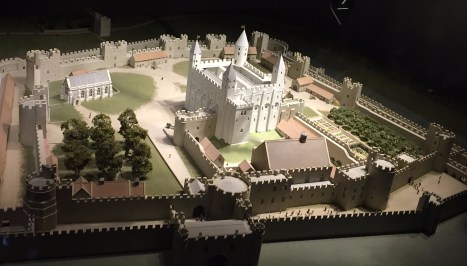
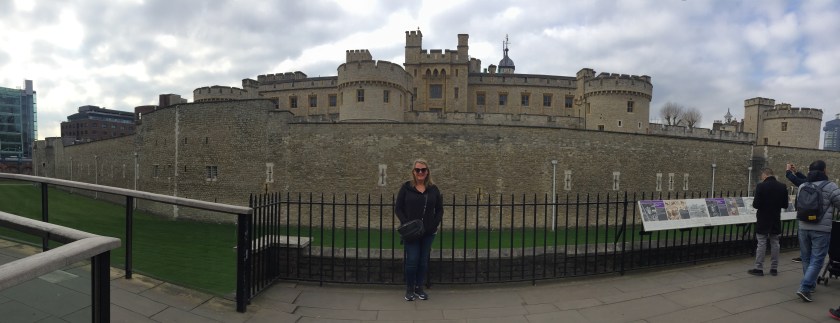 The Tower has been part fortress/royal residence/prison during different times in its history. It is comprised of various buildings (built over centuries) set within defensive walls and a moat. There are twenty-one towers in the Tower of London.
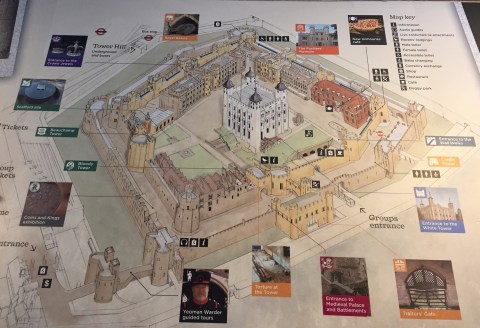
 The Southeast corner of the Tower, the Cradle Tower (early 1300s) and the Well Tower (late 1200s.)


In the Southwest corner of the Tower is the Byward Tower, built in the mid 1200s. Now, it serves as the main tourist entrance.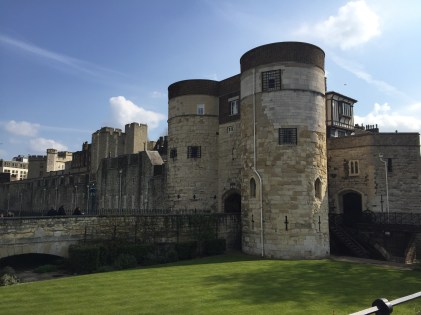 In the middle of the Tower is the central White Tower. Building began by William the Conquerer in 1066 on the keep. It was built as a military stronghold and a royal residence. Over the centuries it’s held many a king (or a deposed king/queen) prisoner. It was whitewashed in 1240 by Henry III.
  The Royal Armories are on display inside- Teenage King Edward’s armor and his father’s, King Henry VIII’a armor. Note the cod piece.


Wooden carvings of the King’s heads. Always love a good bathroom- A Norman Garderobe.
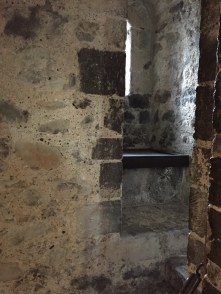 St. John’s Chapel.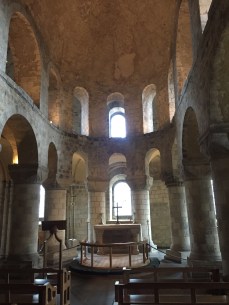


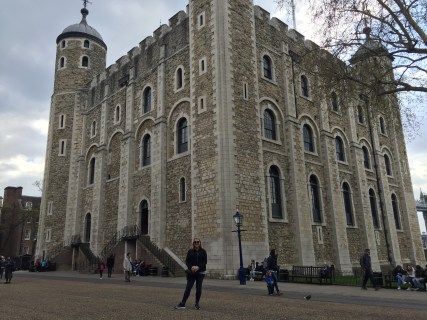 It became less a royal residence and more royal prison in Tudor times. Being “sent to the tower” was not a good thing. Elizabeth I was held here before she was queen in the Bell Tower.
 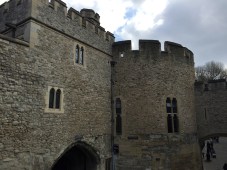 This part of the Tower was built in the mid to late 1200s.


The Hall where the King would meet with his subjects. You can see the remains of the fireplace. The Kings bedchamber and chapel.


During the War of the Roses, a dethroned King Henry was imprisoned in the tower. He died in 1471, some say he was stabbed while in chapel, while others say he died from grief over his son’s death.


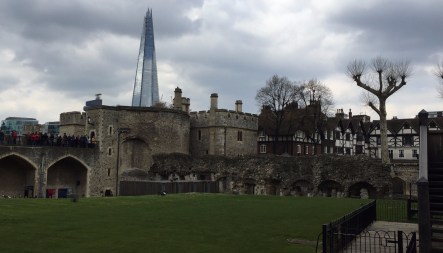 The old Roman city wall. London was founded/invaded by Emperor Claudius and his Roman Army. They built a wall around the city. William the Conqueror built his castle off the remains later.
 Andy in the Inner Ward (Courtyard.)


Traitor’s Gate was originally built by Edward I around 1275 as a water gate entrance from the Thames to the Tower. During Tudor time, it became known as Traitor’s Gate, as many Tudor prisoners were transported through this gate on their way to the Tower.


While most executions (beheadings usually) were a public spectacle on Tower Hill (outside the Tower), a privileged few nobles were accorded the “honor” of dying on Tower Green. Three Queens, two Lords, and two Ladies. The most famous of which being Queen Anne and Queen Katherine. Both wives of King Henry VIII, 2nd and 5th respectively and at least one of them undeserving of such a fate.


The Tower has long been home to Ravens. A list of all the Raven’s names and dates has been kept since 1880. To keep the tradition going, at least six Ravens currently reside in the Tower. The Ravenmaster (yes, that is what he is referred to as) trims some feathers on one wing (it doesn’t hurt them) to keep the birds from flying too far away. They hang around their cages and mingle with the visitors. They are bigger then what I imagined with large sharp-looking beaks; I kept my distance. Leaving through the Middle Drawbridge, built by the Duke of Wellington for military purposes in 1834.
xoxo-sk
ps. They misspelled our name.
 xoxo-sk